7 Things You Should Never Flush With a Septic System

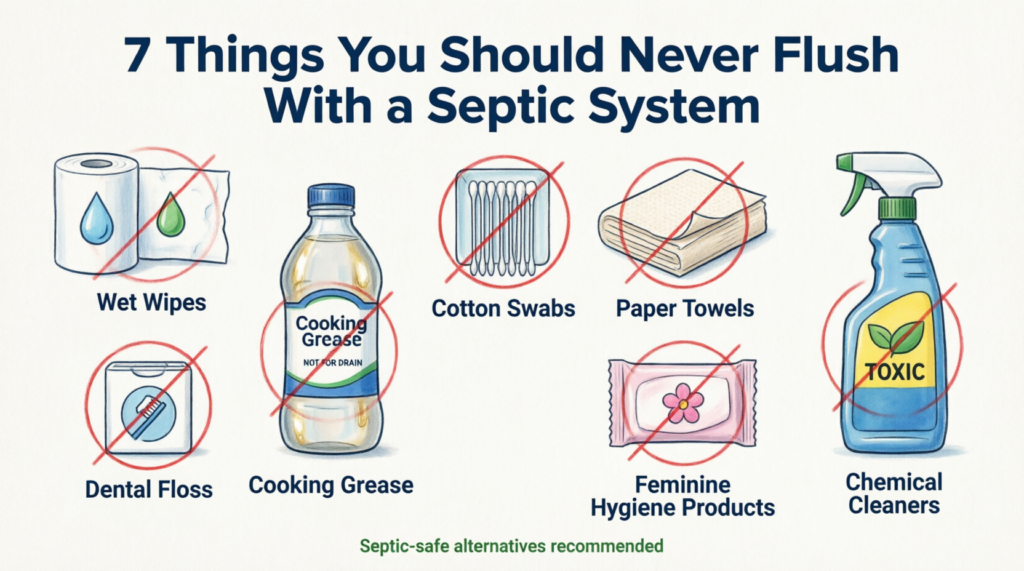
Your septic system is a living ecosystem — not a plumbing fixture. The bacteria inside it do the work of treating your wastewater. Kill those bacteria, clog the pipes, or overload the leaching bed with non-biodegradable material, and you are looking at $20,000 to $40,000 in repairs. Most of that damage is completely preventable.
How Your Septic System Actually Works — and Why This List Matters
Before we get to the list, a quick explanation of why what you flush matters so much — because most homeowners treat their septic system the same way they treat a city sewer connection. That is the root of the problem.
A municipal sewer system takes your waste to a treatment plant staffed by engineers and equipped with industrial-scale filtration and chemical treatment. Your septic system takes your waste to a buried tank in your backyard, where naturally occurring bacteria are the entire treatment process. That is it. Bacteria break down solids, separate liquids, and allow treated effluent to move into the leaching bed for final soil treatment.
The Biological Reality of Your Septic Tank
Inside your septic tank right now, billions of anaerobic bacteria are breaking down solid organic waste into smaller compounds, reducing sludge volume, and allowing clarified liquid to flow through to your leaching bed. These bacteria work continuously without any intervention from you — as long as you do not kill them, starve them, or overwhelm them with material they cannot process. Everything on the list below does one of those three things. The result is premature sludge buildup, overflow into the leaching bed, soil clogging, and eventually system failure that could have been entirely avoided.
1
“Flushable” Wipes
This is the number one cause of preventable septic service calls across Ontario — and the most infuriating, because the packaging literally says you can flush them. You cannot. Not safely, not in a septic system.
Consumer agency testing and wastewater utility studies consistently show that so-called flushable wipes do not break down in septic tanks within any reasonable timeframe. Unlike toilet paper, which is engineered to disintegrate rapidly in water, flushable wipes are made of synthetic fibres designed to stay intact when wet — because that is what makes them useful as a wipe. That same property makes them a disaster in a septic tank.
In the tank, wipes settle into the sludge layer and resist decomposition for months or years. They reduce the tank’s effective capacity, interfere with pump float systems, clog distribution pipes and effluent filters, and accumulate into masses that require emergency pumping to remove. A family that uses wipes regularly and does not pump aggressively often needs pumping two to three times more frequently than households that do not.
What to do instead
Dispose of wipes in the trash — including those labelled “flushable,” “biodegradable,” or “septic safe.” None of those labels are regulated in Canada and none of them mean the product is safe for your tank. If you want the comfort of a wet wipe, keep a small waste bin beside the toilet.
2
Cooking Grease, Fats, and Oils
Grease poured down a kitchen drain is liquid and flows easily — until it cools. Once it hits the cooler temperatures inside your pipes and septic tank, it solidifies. Over time, it builds up into a thick scum layer on top of the liquid in your tank that the bacteria in your tank cannot effectively break down.
A thick grease scum layer does two things: it reduces your tank’s working capacity, requiring more frequent pumping, and it eventually reaches a thickness where it begins overflowing through the outlet pipe into the leaching bed. Once grease reaches the leaching bed, it coats the stone and soil, dramatically accelerating biomat formation and permanently reducing the bed’s absorption capacity.
Bacon grease, cooking oils, butter, meat fats, salad dressing — all of it. It does not matter whether it is animal or vegetable-based. None of it belongs in your system.
What to do instead
Pour cooled grease into an old container — a coffee tin, an empty jar, a milk carton — let it solidify fully, and dispose of it in your regular garbage. Wipe greasy pans with a paper towel before washing to remove the bulk of the fat before water ever touches the pan.
3
Medications — Especially Antibiotics
Flushing expired or unused medications is a habit that seems harmless and environmentally responsible — after all, you are not putting them in the landfill. But for a septic system, particularly antibiotics, this habit is actively destructive.
Antibiotics are designed to kill bacteria. The bacteria in your septic tank are essential to the treatment process. When antibiotics enter the tank, they do exactly what they are designed to do — they kill bacteria indiscriminately, including the beneficial anaerobic bacteria your system depends on. A significant dose of antibiotics from flushed medications can substantially disrupt the biological balance in your tank, slowing waste breakdown and increasing the rate of sludge buildup.
Beyond the impact on your system, medications that pass through a septic system largely intact can contaminate groundwater and affect local ecosystems. Antibiotics entering groundwater contribute to antibiotic resistance — a public health concern that extends well beyond your property line.
What to do instead
Canadian pharmacies participate in the MedReturn program — bring unused or expired medications back to any participating pharmacy for safe disposal. Your local municipality may also run periodic medication take-back events. Never flush medications, and never put them directly in your household garbage without checking local guidelines first.
4
Harsh Chemical Cleaners and Drain Openers
Chemical drain openers, antibacterial cleaners, bleach in large quantities, ammonia-based products, and solvents are all harmful to your septic system’s bacterial ecosystem. These products are designed to kill microorganisms or dissolve organic material through chemical reactions — neither of which is compatible with a system that depends on living bacteria to function.
A single dose of liquid drain cleaner poured into a slow drain sends a concentrated caustic chemical directly into your septic tank. Drain cleaners typically contain sodium hydroxide (lye) or sulfuric acid — both of which create a highly alkaline or acidic environment that kills bacteria and can corrode tank components and pipes over time.
Regular use of antibacterial hand soaps and surface cleaners in modest quantities is generally not a problem — the concentrations are too low to cause significant disruption. The issue is heavy regular use of concentrated products, particularly drain cleaners, toilet bowl cleaners with heavy chemical content, and anything containing bleach in large amounts.
What to do instead
For slow drains, use a drain snake or plunger before reaching for a chemical solution. For routine cleaning, white vinegar, baking soda, and mild biodegradable soaps are effective and safe for septic systems. If you need to use bleach, use it sparingly and diluted — an occasional load of laundry with bleach will not kill your tank. Pouring a litre of concentrated bleach down the drain will cause real damage.
5
Cat Litter — Including “Flushable” Varieties
Cat litter — regardless of what the packaging says — should never enter a septic system. Traditional clay-based litter absorbs water and swells, behaving like liquid cement inside your pipes and tank. Even “flushable” or biodegradable litters made from wood, paper, corn, or wheat present serious problems for septic systems.
The volume issue alone is significant. Cat litter is designed to absorb large volumes of liquid and expand. In a septic tank, this behaviour reduces working capacity rapidly and accelerates sludge accumulation. The material also does not break down reliably in the anaerobic environment of a septic tank, even varieties marketed as biodegradable.
Beyond the mechanical damage, cat waste can introduce Toxoplasma gondii — a parasite that standard septic treatment does not reliably neutralise — into the groundwater. If your property relies on a private well, this is a specific and serious health concern.
What to do instead
Dispose of cat litter in the household garbage — sealed in a bag. There is no safe alternative method for septic system owners. The “flushable” labelling on cat litter products is not regulated and should not be trusted.
6
Feminine Hygiene Products, Cotton, and Paper Towels
Tampons, pads, cotton balls, cotton swabs, paper towels, and similar products share a critical property: they are designed to absorb liquid and either expand or remain intact when wet. This is the opposite of what you need in a septic system. Unlike toilet paper — specifically engineered to rapidly disintegrate in water — these products resist decomposition and accumulate in the sludge layer.
Tampons in particular are frequently cited in septic service calls. They absorb liquid, expand significantly, and are made of materials that bacteria cannot break down efficiently. A few tampons flushed over time is a minor contribution. A habit of flushing them over years is a meaningful factor in accelerated sludge buildup and, eventually, distribution system clogging.
Paper towels deserve special mention because many homeowners assume they are similar enough to toilet paper to be safe. They are not. Paper towels are engineered to remain strong when wet — that is their purpose. Their durability in a wet environment is exactly why they should not go anywhere near a septic tank.
What to do instead
Keep a small covered waste bin in every bathroom and make it the default disposal for everything that is not human waste or toilet paper. Feminine products, cotton items, paper towels, dental floss, contact lenses, and bandages all belong in that bin. The only things that belong in a septic system are human waste and toilet paper — full stop.
7
Coffee Grounds, Food Scraps, and Garburator Waste
Coffee grounds are among the most common kitchen items that homeowners rinse down the sink without a second thought — and one of the most consistently harmful to septic systems. Coffee grounds do not dissolve in water. They do not break down reliably in a septic tank’s anaerobic environment. They accumulate in the sludge layer as a dense, fine-particle material that is slow to decompose and contributes significantly to sludge volume over time.
Garburators (garbage disposals) deserve special attention. Many rural Ontario homeowners believe a garburator is compatible with a septic system — it is not. A garburator shreds food waste into small particles and sends them directly into the septic tank. This significantly increases the organic load the tank must handle, accelerates sludge accumulation, and requires more frequent pumping. Some Ontario Health Units specifically recommend against installing garburators on septic systems.
Beyond coffee grounds, starchy foods (rice, pasta, potatoes), fibrous vegetables (celery, corn husks), and eggshells are particularly problematic. Starchy foods swell in the tank and resist decomposition. Fibrous materials tangle and clog. Eggshells add an inorganic mineral component that accumulates as sediment the bacteria cannot process.
What to do instead
Coffee grounds are excellent compost material — add them to your compost bin or garden directly. Food scraps belong in the compost or garbage. If you have a garburator installed, use it sparingly and pump your tank more frequently than the standard schedule — every two to three years instead of four to five. If you are planning a new build, skip the garburator entirely.
The Myth of Septic Additives
While we are on the topic of what to put in your system — septic additives, bacterial treatments, and enzyme products deserve a direct answer. The scientific consensus, supported by research from Environment Canada and multiple university studies, is that these products provide no meaningful benefit to a properly functioning septic system. A healthy tank already contains billions of naturally occurring bacteria doing exactly what the additive claims to do. The only thing that reliably extends system life is pumping on schedule and keeping harmful items out. Save the money you would spend on additives and put it toward your next pump-out.
What Should Go Into Your Septic System
After seven things that should not go in, here is the complete list of what should:
✅ The Complete Safe List
- Human waste — the system is designed for exactly this
- Toilet paper — standard single or double-ply. Look for “septic safe” labelling if you want extra assurance, though most standard toilet paper dissolves rapidly enough in a functioning system
- Water — from all household fixtures, though excessive volumes from leaky toilets, simultaneous laundry loads, or large gatherings can cause hydraulic overload
- Biodegradable soaps and detergents — in normal household quantities. Avoid antibacterial formulations where possible
- That is the complete list — everything else requires more thought before it goes down the drain
The Quick Reference — What Goes Where
| Item | Flush / Drain? | Where Instead |
|---|---|---|
| “Flushable” wipes | Never | Bathroom waste bin |
| Cooking grease / oils | Never | Sealed container → garbage |
| Medications (any type) | Never | Pharmacy take-back program |
| Chemical drain cleaners | Never | Use a drain snake instead |
| Cat litter (any type) | Never | Sealed bag → garbage |
| Feminine hygiene products | Never | Bathroom waste bin |
| Paper towels | Never | Garbage or compost |
| Cotton balls / swabs | Never | Bathroom waste bin |
| Coffee grounds | Never | Compost bin |
| Food scraps | Never | Compost bin or garbage |
| Dental floss | Never | Bathroom waste bin |
| Bleach (small amounts) | Sparingly | Use diluted; avoid concentrated |
| Antibacterial soap (small amounts) | Sparingly | Use standard soap where possible |
| Human waste | Yes | — |
| Toilet paper (standard) | Yes | — |
One More Thing — Water Volume Matters Too
What you flush is one half of the equation. How much water you put through the system is the other. Your septic system was designed to handle a specific daily volume of wastewater — calculated from your bedroom count under Ontario’s Building Code (approximately 350 litres per bedroom per day as a baseline). Consistently exceeding that volume overloads the leaching bed, prevents proper settlement in the tank, and pushes solids through before they have been properly treated.
- Fix leaky toilets immediately — a running toilet can add 100 to 400 litres per hour to your system, which is the equivalent of an extra person or two living in your home around the clock
- Spread laundry loads across the week — doing five loads on Saturday morning sends the equivalent of a day’s worth of water through the system in a few hours
- Be cautious during large gatherings — cottage weekends and family events can put the system through two or three times its normal daily load in a single day
- Install low-flow fixtures where possible — low-flow toilets and showerheads reduce daily water consumption without impacting function
The Single Best Thing You Can Do
Beyond avoiding the items on this list, the single most effective action you can take to extend your system’s life is pumping your tank on schedule — every three to five years for a full-time household of four. A $350 pump-out removes accumulated sludge, gives the pumper a chance to inspect the tank condition, and resets the clock on solids buildup. Homeowners who pump consistently almost always avoid emergency replacements. Homeowners who pump reactively — only when something goes wrong — almost always end up paying for a leaching bed replacement that regular maintenance would have prevented for another decade.
Already Seeing Warning Signs?
If you are noticing slow drains, odours, or wet spots over your leaching bed — the time to act is now, not after the backup. We can help with a free quote, a site assessment, or a referral to a vetted installer in your area.